
Share

As a testament to how fast things are moving, we must note that Clay’s pricing has changed slightly in the weeks between the initial writing of this post and the final publication. Take this post as a snapshot in time, with the recognition that it may, very quickly, again become outdated.
“[W]e’d rather expand access and bet on our customers succeeding and growing with us, rather than gatekeeping some of Clay’s best capabilities…”
—Clay’s internal memo
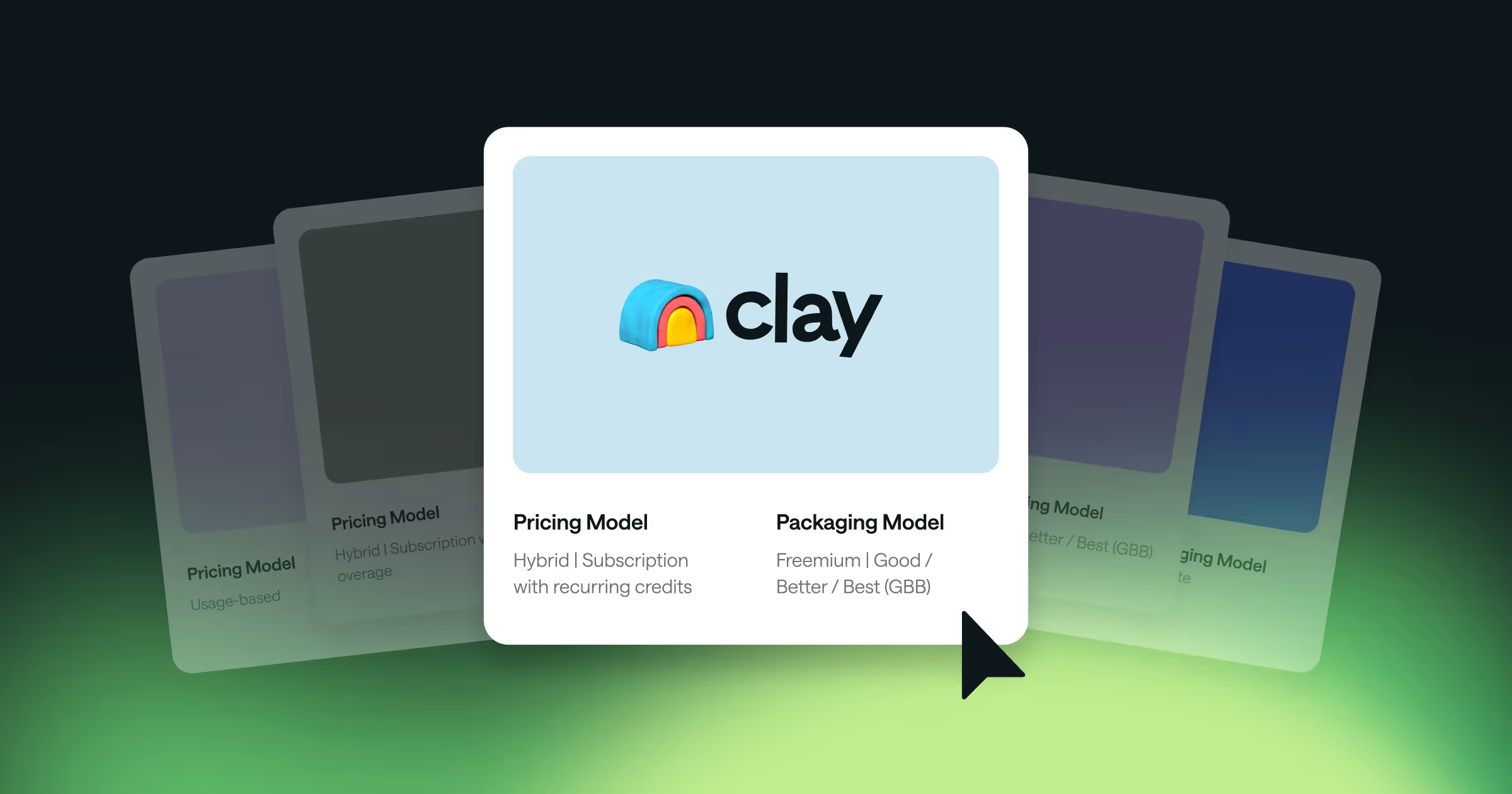
Earlier this year, we launched our Pricing Model Index, and after reviewing the strategies of over 50 leading AI and usage-based companies, we’ve clearly seen a market in the middle of a massive identity shift: the per-seat model is crumbling, and the Value Era is definitely here.
High-level data only tells half the story. To truly understand how the best in the business are defining and capturing value today, we’re diving into a Pricing Model Spotlight series. Here, we’ll go under the hood of the most innovative companies in the category to analyze the big bets they’re making on credits, outcomes, and pricing models.
Our goal is to provide a roadmap for founders and product leaders who are trying to solve the hardest puzzle in SaaS today: How do you price for an AI future without leaving revenue on the table?
Let’s kick things off with Clay, a company that recently overhauled its own pricing model in a move that might stand to be the harbinger of what’s coming.
Clay is the definitive example of a shift toward what might be called utility-density pricing. Earlier this year, the company made a significant change and released an internal memo that detailed the fundamental overhaul of its economic structure. This was a major change in what they charge for, shifting from their now-outgrown role as data reseller to more of a GTM engineering platform model.
The core innovation: Dual-currency packaging
The most significant change in Clay’s 2026 model is their separation of Data Credits from Actions.
Historically, Clay operated on a single-credit system. Every record you enriched or every AI task you ran drew from one bucket. In the new model, Clay splits these into two distinct currencies to reflect two different value propositions:
- Data Credits (the commodity) are used to purchase third-party data from Clay’s marketplace. In a decisive strategic move, the company slashed these costs by 50–90% across their top enrichments.
- Actions (the value) are a new meter for platform operations: AI research tasks, HTTP API calls, CRM pushes, and waterfall routing.
With this separation, Clay effectively commoditizes the data layer so they can win the orchestration layer. By passing on to customers the volume discounts they get from data providers (often with zero or minimal markup), there’s no more incentive for a customer to bring their own keys just so they can save money. Clay wants you to buy your data through Clay because it’s now as cheap as buying it direct, but is significantly more convenient.
The logic of actions and activity ceilings
One of several risks Clay leadership identified in their publicly disclosed memo was that of customers hitting a ceiling on their activity in Clay, or experimenting less out of wariness that they might just because every click or automation is tied to a high-cost credit.
To solve this, they set Action limits high, so their customers can work without worry. As of their launch, a standard Launch plan at $185/month (now $167/month) came with 15,000 Actions and 2,500 Data Credits per month. According to the insights they shared, their internal data suggests that roughly 90% of customers will never hit that Action ceiling.
This is also a clever psychological play. By giving users what seems like an excessive amount of Actions, Clay encourages them to build heavy workflows without feeling like they’re draining their budget. Once a user has built, say, an automation that relies on 50 Actions per lead, they’re more likely to stay with Clay.
Lowering the floor on product stickiness
As part of this overhaul, Clay consolidated three self-serve tiers into two. The most strategic part of this was the move of enterprise-lite features like CRM Sync, HTTP APIs, and Webhooks from the old $800/mo Pro tier into the new $495 Growth tier (now $446), making those features more accessible to non-enterprise users. The continued theme here is that the company is making clear, purposeful moves that optimize their long-term vision, even if it seems counterintuitive in the shorter term.
If a customer whose CRM is automatically enriched via an HTTP API is now seen as a sort of "GTM Engineer" who’s built a permanent piece of infrastructure, Clay is accelerating its user base’s integration depth by making these features +$300 cheaper per month.
The BYOK trade-off
While the pricing update was generally a price cut for marketplace users, it did also introduce a new cost for bring-your-own-key power users.
Under the old model, using your own API keys for data providers meant you weren't charged for the orchestration of that data. Now, even bring-your-own-key (BYOK) data provider workflows consume Actions. One exception is BYOK for AI model keys, with OpenAI being the most common, which still costs zero Actions, a distinction Clay preserves.
This is Clay’s platform tax, signaling that they no longer view themselves as a gateway to other people’s data but as a software platform that deserves to be paid for its orchestration work and the value customers get from that work. Even if you bring your own fuel (aka the data), you still have to pay for the engine that is Clay Actions.
The 10% revenue bet
With all these moves comes perhaps the most telling piece of evidence for Clay's long-term thinking, which is their matter-of-fact acceptance of their projected revenue decline.
In an industry where pricing updates can be thinly veiled price hikes, Clay chose to intentionally shrink their data margins. They’re keen to something timely that’s happening. In 2026, data is a commodity, but orchestration is much more than that. They’re betting that by making it 90% cheaper to enrich one lead, users will enrich 10x more leads. As those users scale over time, they’ll eventually hit the generous Action ceiling, triggering upgrades to higher tiers where the real margins live.
Key takeaways for founders and GTM leaders
Commoditize the input. Price the value.
If your product relies on third-party APIs, you might not want to make your margin on the markup. Pass the savings to the user and charge for the work your software does.
Lower the barrier to stickiness.
If certain features (like APIs or CRM syncs, in Clay’s case) make your product harder to churn from, moving them to lower-priced tiers can increase your product’s stickiness. The long-term LTV of a more deeply integrated customer far outweighs the short-term MRR of a premium feature gate.
This is the first post in our Pricing Model Spotlight series. Take a closer look at many other companies' pricing models in our Pricing Model Index.





.png)
%25202%2520(1).png)

.png)