
Share

Software pricing has always been a mirror of its era. From perpetual licenses that reflected the economics of physical distribution to per-seat SaaS that mapped cleanly onto org charts and budget cycles, each model made sense for its moment in time. But the arrival of AI agents may represent something more disruptive than a new pricing trend: a fundamental break in the assumptions that have guided commercial models for decades.
In a recent episode of the Mostly Growth podcast, Metronome CEO Scott Woody joined to explore what happens to pricing in a future where the buyer is no longer human. The shift in pricing becomes an architectural mandate, where companies must account for the purchasing processes of AI agents, and legacy, human-paced infrastructure begins to break. As we sit squarely in the Value Era, where usage-based structures align cost with realized outcomes, it’s worth examining what the future might look like in a new era of software value: the Agentic Era.
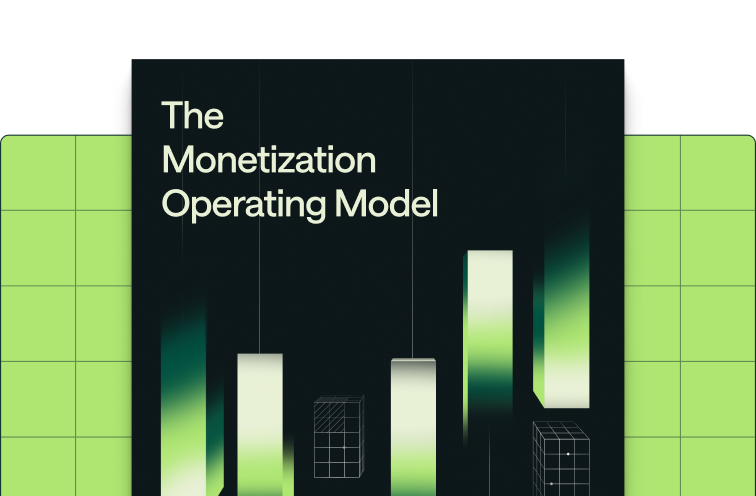
Which pricing era are we in now? Get oriented with the Monetization Operating Model whitepaper.
The shift from seats to work
In the Access Era, software was valued by how many people had access to a shared tool or source of truth. This seat model worked, if imperfectly, because humans were the ones doing the work. In the episode, Scott touched on how pricing was introduced within SaaS pricing as a human construct, where decisions have been made on a wealth of research into how humans make buying decisions. Tiered pricing, high anchors, good/better/best packaging—all examples of how pricing has been structured for human processing.
In the Agentic Era, it’s unlikely that the buyers will function within this mental construct or constraints. This era is likely better suited for outcomes and price optimizations, where agents can evaluate thousands of variables simultaneously.
Scott noted that this inverts a core assumption: rather than wanting fewer levers, as humans do, agents may actually benefit from more of them. One example is the pricing page, which was built for human comprehension. In the Agentic Era, pricing pages could become less relevant over time as agent-to-software interactions become more common.
The shift from plan selection to budget allocation
Another useful mental model Scott covered is what the end-state of agent-driven purchasing might look like. Rather than a human buyer evaluating plans and selecting the one that fits, the interaction might look more like a human setting a budget and a set of priorities, then delegating the actual spending decisions to an agent.
The analogy he used is a marketing budget. A CMO isn't evaluated on which line items they spent against—they're measured on outcomes. The negotiation isn't "Which plan did you buy?" but "How much did you allocate, and what did you get for it?" Applied to software, this suggests the commercial conversation may migrate away from packaging and toward goal-setting and resource allocation.
It's worth noting this is still largely a forward-looking frame. Most software purchasing today still runs through human evaluation. But understanding where the logic is heading can help teams build infrastructure and commercial models that won't require rebuilding from scratch when the transition accelerates.
Transacting at the speed of code
Traditional software billing was designed for the human speed of buying, where a person makes one decision, pays a monthly fee, and rarely checks if they are overpaying. But AI agents operate in milliseconds, constantly calculating the ROI of every single task (like a single LLM call) against its cost.
If your pricing is a monthly bundle, you’re likely not providing enough transparency for an agent buyer. An agent programmed to protect a user's budget may see a recurring subscription as a black box of inefficiency and will instead search for a more ideal structure. In this new era, "optimization" (where your customer expects a clear value to cost equation) means the ability to keep pace with change and meet customers where they are. Focusing on optimization as a strategic lever will be a critical consideration. To win an agent's business, your monetization strategy must support the speed and precision of the AI agents themselves.
Credits as a tool, not a metric
The use of credits in a pricing model generates a lot of debate in monetization conversations. They work well in specific contexts and tend to break down in others.
In sales-led motions, credits serve a useful function by adding abstraction, creating negotiation surface, and allowing for last-mile discounting without changing list prices. A sales process can absorb that complexity because there's a human on both sides to explain and interpret the terms. In product-led or self-serve motions, complex credit models tend to struggle. Without a sales process to translate value into credits and back again, the abstraction becomes a barrier rather than a feature.
But when your buyer is an agent, and no sales conversation even needs to be had, that complexity can be absorbed , and the agent can make the purchasing decision at any level of complexity. Scott's framing is that the category error to watch for is deploying a complex credit model in a context where there's no mechanism to help the buyer make sense of it.
The cost of rigid infrastructure
In a human-centric world, "good enough" billing may create friction. In an agentic world, it may become a constraint on growth. While this agentic future is still playing out, a few risks are worth pressure-testing as agent-driven purchasing matures.
Pricing transparency. Agents optimizing against a budget will likely want clear, real-time signals about what things cost and what value they're getting. Opaque or bundled pricing structures may create friction for agent-driven decision-making. If agent-driven purchasing becomes more common, providers with granular, queryable pricing data may have an advantage.
Reduced switching friction. Human inertia can be a force in retention. Agents may not carry that same inertia. Whether they'll autonomously migrate workloads between providers remains to be seen, but if that dynamic holds, value-to-cost alignment may become more important over time.
Nonlinear usage patterns. Agent activity can be bursty and nonlinear. Infrastructure designed around legacy consumption patterns may struggle to meter, rate, or process agent-driven demand accurately. This may leave revenue on the table or create a poor experience for the end customer.
None of these outcomes is certain. But they are reasonable questions for any team building commercial infrastructure today: will this system hold up when the buyer is a machine?
Monetization for the Agentic Era
The companies that thrive in this next decade will be those that treat monetization as a product feature. By bridging the gap between product activity and financial outcomes, businesses can move as fast as the agents they serve.
The inflection point is approaching quickly. The advantage will go to the teams whose infrastructure is ready.